Evol-CM-to-TM
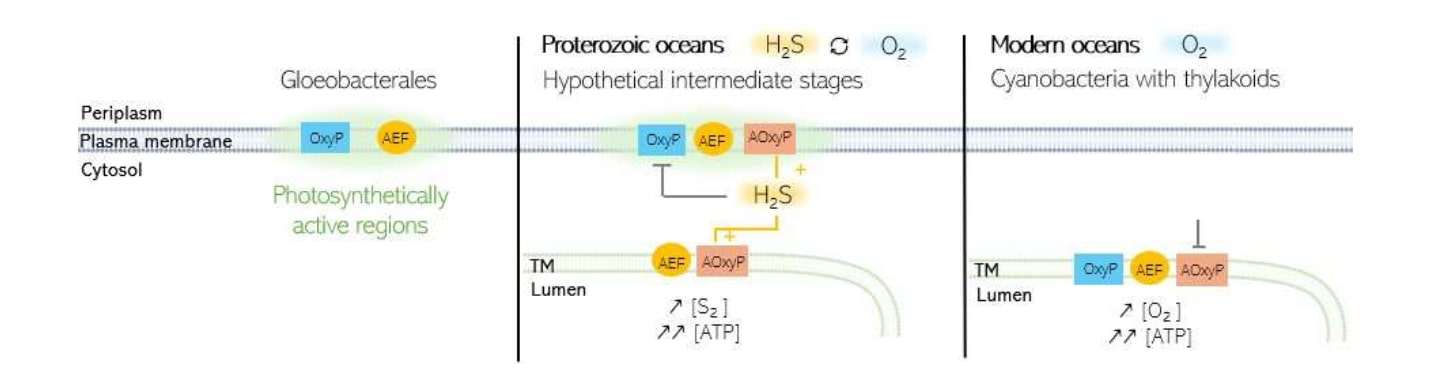
Cyanobacteria are the only prokaryotes that perform oxygenic photosynthesis by utilizing two photosystems in their electron transport chain (ETC), with photosystem II (PSII) splitting water molecules. In most cyanobacteria, this process occurs within the membranes of specialized compartments called the thylakoids. The process by which the ETC is integrated into the thylakoids has been studied for certain subunits and involves the coordination of numerous assembly factors, of which only a fraction has been identified so far. In Gloeobacterales, the most basal group of extant cyanobacteria, these photosystems and the ETC are instead integral to the plasma membrane. While recent studies suggest an appearance of oxygenic photosynthesis well before the Great Oxidation Event (GOE), the structural advantages of thylakoids hint to a key role in GOE, though their origin remains unclear. The aim of this project is to test the hypothesis that the emergence of thylakoids is related to anoxygenic photosynthesis and alternative electron flows, conferring an advantage in the photic zone of Proterozoic oceans, where oxic and sulfidic-rich conditions coexisted. In this project, metabolic modelling by flux balance analysis will be used to test hypothetical evolutionary stages of thylakoids in simulated conditions.